
The First Thanksgiving
Take for example the progenitor event all those years ago in the 17th century. As the quasi-historical story goes, in 1621 the "Pilgrims" left for the "new" world for "religious reasons" and "landed" on Plymouth Rock.
(Just about every element in that last sentence needs qualification: only about half of the travelers on the Mayflower were motivated by religious reasons, they weren't "Pilgrims" so much as "Separatists" escaping from the Church of England, they didn't wear all black with the iconic tall hat and buckle, the world they were sailing to wasn't "new" at all but had been discovered by not only Native Americans but also by other Europeans, and they didn't land on Plymouth Rock but first weighed anchor at Cape Cod to set up the infamous Mayflower Compact. But let's not let the facts get in the way of a good story here.)

With Squanto's help the Pilgrims survived the first winter and yielded a good harvest in the next season. In celebration of the good harvest the Pilgrims and their new Native American allies threw a three day feast, the first Thanksgiving!
The Implicit Theology
Americans today look back to that original event for historical roots to their own Thanksgiving holiday celebration and seem to add a layer of problematic theology. The theology of Thanksgiving seems to go something like this modus ponens:
P1. If God is the sole dispenser blessings and fortune (B), then the proper response is thanksgiving to God (TG).
P2. God is the sole dispenser blessings and fortune (B).
C1: Therefore the proper response is thanksgiving to God (TG).
or in symbolic form,
B -> TG
B
Therefore, TG
The logic of this argument is irrefutably valid, it's a modus ponens after all, however since one of its major premises is untrue the argument necessarily crumbles like an unstable Jenga tower. The faulty premise is B, ie the claim that God is the sole dispenser blessings and fortune. Quibbling with B may at first seem a bit ironic coming from a devout practicing Christian, nonetheless I take serious umbrage with the claim.
 The Troubling Thanksgiving Theodicy
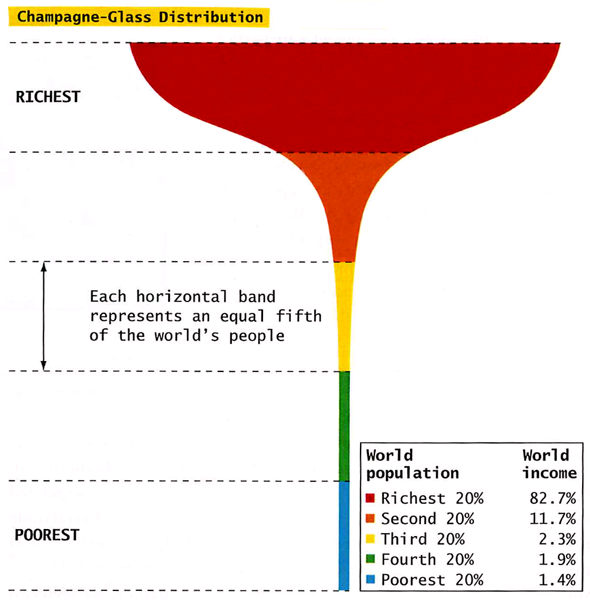
One of the most problematic implications of the premise that God is the sole dispenser of blessings and fortune is that it is hard to reconcile the truth of B with the obvious fact that in the world there are those who are so much more blessed than others. If God is the sole dispenser and cause of blessing and fortune then God is also the cause of misfortune and everything that goes badly, including today's drastic social and economic global disparity.
If God was the cause of the Pilgrims' good fortune, then wasn't God also the cause of their misfortune during winter? If God is responsible for causing fortunes in the world, for good and for bad, then on Monday God may be a benevolent sprirt to be thanked, and on Tuesday a malevolent demon to be cursed.
And on a related note, if God is the cause of such things as the global economic disparity, and there is perhaps some Biblical justification for asserting that God gives wealth to some for the purposes of dispensing justice, then is the proper way of thanking God for our outrageous relative wealth to gorge ourselves on an eight course meal, or would a better practice be prayer, fasting, and stewardship?!
[Aside: Biting the Bullet]
[I'm an Open Theist so I object the premise that God is this interactive with the world, but I must admit that there seems to be a Biblical warrant for simply biting the bullet here and admitting that God is to be both praised for our good blessing and trusted and blamed when things go wrong. God is in control of absolutely everything, we are in the palm of His hand, and we must simply trust Him. Whether God is making the wine flow, or pouring Babylon over us like a pot of boiling water, God is in control and we trust that in the end He will bless us. There is strong Biblical warrant for this, especially in the OT, but I can't get on board with it because I can't see a good God causing pain, even if it's temporary or teleological.]

One strategy of wiggling out of the theodicy issue, which keeps B in tact, is to argue that God's dispensing fortunes and blessings to us is a function of our faithfulness; ie the more faithful one is the more God will bless them. This is what's called "The Gospel of Prosperity," and its about as ugly, and dubious, as it is popular in our Country.
While this does indeed wiggle out of the theodicy issue, and preserve B, it runs into four troubling issues immediately. The first is that it's doubly cruel to the poor. The poor are not just pitiful, but they are poor because God has caused them to be that way, and God has caused them to be poor because of their own doing. Charity then would be resisting the due punishment of God. Talk about insult to injury!
The second devastating problem for the Gospel of Prosperity is that it's simply easily debunked by even a cursory examination of the world. If God's blessings were a function of our faithfulness, then why do jerks seem to have it so good and saints get nailed to trees? Why do Wall Street Bankers make tens of millions of dollars and earnest school teachers make less than minimum wage?
A third with the Gospel of Prosperity strategy is that its explicitly countered in the Bible time and time again. The entire purpose of the story of Job is to show that faithfulness and fortune are not correlated in any way, and Jesus asserts several times that the poor are not poor because of anything they have done (cf John 9:1-2).
In fact Jesus goes so far at points to completely undermine the Gospel of Prosperity by asserting the exact opposite correlation between faithfulness and fortune: "If anyone desires to come after Me, let him deny himself, and take up his cross, and follow me" (Matt 16:24). Faithfulness and fortune may in fact have a causal relationship, but it's an inverted one!
"The LORD Be With You"
What would a better theology and practice of thanks look like? I don't know the answer to that, as I'm more of a smasher of other people's ideas than I am of a builder of theories, but here is one attempt at a promising start.
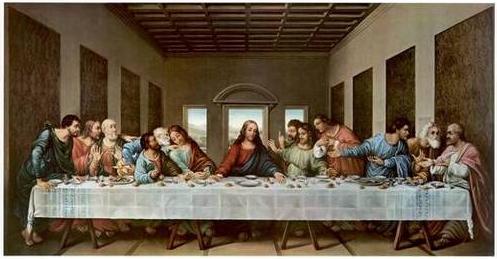
A theology of thanksgiving that may be superior would be to simply give thanks to God in the way we have been doing for thousands of years every Sunday in the Eucharist: gathering the family together for prayer and food in the Great Thanksgiving of Eucharist to give thanks to God for what God has done, what God is doing, and what God will do.
Surely we are on safer ground when instead of thanking God for supposedly blessing us with health, wealth, and happiness, we give thanks to God for sending God's son Jesus, the Jewish Christ/Messiah, the one LORD incarnate, and savior of all to take on our nature, teach us, and assume our sinful form in order to put it to death. Or said in a much better way:
"Holy and gracious Father: In your infinite love you made us for yourself; and, when we had fallen into sin and become subject to evil and death, you, in your mercy, sent Jesus Christ, your only and eternal Son, to share our human nature, to live and die as one of us, to reconcile us to you, the God and Father of all. He stretched out his arms upon the cross, and offered himself, in obedience to your will, a perfect sacrifice for the wold world....Therefore we proclaim the mystery of faith...[and] We celebrate the memorial of our redemption, O Father, in this sacrifice of praise and thanksgiving" (BCP 362-3).
Surely this is something that everyone can give thanks for and "it is a right, and good, and joyful thing, always and everywhere to give thanks" to God.


No comments:
Post a Comment