Check out my recent post on www.ChurchRatings.Directory, click here. It's a short piece on a shocking episode I had in a Sunday School class in an Episcopal Church that I used to work at.
Wednesday, January 14, 2015


Friday, November 29, 2013
Thinking Theologically about Thanksgiving
Thanksgiving is one of America's most beloved holidays, and for good reason. It has all the right
 ingredients for a heart warming wholesome event: family, friends, football, food, travel, a parade, Charlie Brown, its a federal holiday, and has a healthy dose of sentimental historical mythos. I enjoy Thanksgiving for all those reasons, especially the food, but I've always found the undergirding theology a bit problematic. Let me explain why.
The First Thanksgiving
Take for example the progenitor event all those years ago in the 17th century. As the quasi-historical story goes, in 1621 the "Pilgrims" left for the "new" world for "religious reasons" and "landed" on Plymouth Rock.
(Just about every element in that last sentence needs qualification: only about half of the travelers on the Mayflower were motivated by religious reasons, they weren't "Pilgrims" so much as "Separatists" escaping from the Church of England, they didn't wear all black with the iconic tall hat and buckle, the world they were sailing to wasn't "new" at all but had been discovered by not only Native Americans but also by other Europeans, and they didn't land on Plymouth Rock but first weighed anchor at Cape Cod to set up the infamous Mayflower Compact. But let's not let the facts get in the way of a good story here.)
 Setting up a colony in a new world is hard, and especially so if you land during a harsh winter in New England. Of the 100 or so settlers that landed in Massachusetts about half of them died within a few months. As an extraordinary stroke of luck would have it, a Native, they came to call Squanto, who just happened to be both friendly and English speaking, one day just walked right into the middle of their new settlement! With Squanto's assistance the local Wampanoag tribe donated stores of food to the settlers, and taught them how to farm the land and fish for eel.
With Squanto's help the Pilgrims survived the first winter and yielded a good harvest in the next season. In celebration of the good harvest the Pilgrims and their new Native American allies threw a three day feast, the first Thanksgiving!
The Implicit Theology
Americans today look back to that original event for historical roots to their own Thanksgiving holiday celebration and seem to add a layer of problematic theology. The theology of Thanksgiving seems to go something like this modus ponens:
P1. If God is the sole dispenser blessings and fortune (B), then the proper response is thanksgiving to God (TG).
P2. God is the sole dispenser blessings and fortune (B).
C1: Therefore the proper response is thanksgiving to God (TG).
or in symbolic form,
B -> TG
B
Therefore, TG
The logic of this argument is irrefutably valid, it's a modus ponens after all, however since one of its major premises is untrue the argument necessarily crumbles like an unstable Jenga tower. The faulty premise is B, ie the claim that God is the sole dispenser blessings and fortune. Quibbling with B may at first seem a bit ironic coming from a devout practicing Christian, nonetheless I take serious umbrage with the claim.
 The Troubling Thanksgiving Theodicy
One of the most problematic implications of the premise that God is the sole dispenser of blessings and fortune is that it is hard to reconcile the truth of B with the obvious fact that in the world there are those who are so much more blessed than others. If God is the sole dispenser and cause of blessing and fortune then God is also the cause of misfortune and everything that goes badly, including today's drastic social and economic global disparity.
If God was the cause of the Pilgrims' good fortune, then wasn't God also the cause of their misfortune during winter? If God is responsible for causing fortunes in the world, for good and for bad, then on Monday God may be a benevolent sprirt to be thanked, and on Tuesday a malevolent demon to be cursed.
And on a related note, if God is the cause of such things as the global economic disparity, and there is perhaps some Biblical justification for asserting that God gives wealth to some for the purposes of dispensing justice, then is the proper way of thanking God for our outrageous relative wealth to gorge ourselves on an eight course meal, or would a better practice be prayer, fasting, and stewardship?!
[Aside: Biting the Bullet]
[I'm an Open Theist so I object the premise that God is this interactive with the world, but I must admit that there seems to be a Biblical warrant for simply biting the bullet here and admitting that God is to be both praised for our good blessing and trusted and blamed when things go wrong. God is in control of absolutely everything, we are in the palm of His hand, and we must simply trust Him. Whether God is making the wine flow, or pouring Babylon over us like a pot of boiling water, God is in control and we trust that in the end He will bless us. There is strong Biblical warrant for this, especially in the OT, but I can't get on board with it because I can't see a good God causing pain, even if it's temporary or teleological.]
 From the Pot into the Fire: The Gospel of Prosperity
One strategy of wiggling out of the theodicy issue, which keeps B in tact, is to argue that God's dispensing fortunes and blessings to us is a function of our faithfulness; ie the more faithful one is the more God will bless them. This is what's called "The Gospel of Prosperity," and its about as ugly, and dubious, as it is popular in our Country.
While this does indeed wiggle out of the theodicy issue, and preserve B, it runs into four troubling issues immediately. The first is that it's doubly cruel to the poor. The poor are not just pitiful, but they are poor because God has caused them to be that way, and God has caused them to be poor because of their own doing. Charity then would be resisting the due punishment of God. Talk about insult to injury!
The second devastating problem for the Gospel of Prosperity is that it's simply easily debunked by even a cursory examination of the world. If God's blessings were a function of our faithfulness, then why do jerks seem to have it so good and saints get nailed to trees? Why do Wall Street Bankers make tens of millions of dollars and earnest school teachers make less than minimum wage?
A third with the Gospel of Prosperity strategy is that its explicitly countered in the Bible time and time again. The entire purpose of the story of Job is to show that faithfulness and fortune are not correlated in any way, and Jesus asserts several times that the poor are not poor because of anything they have done (cf John 9:1-2).
In fact Jesus goes so far at points to completely undermine the Gospel of Prosperity by asserting the exact opposite correlation between faithfulness and fortune: "If anyone desires to come after Me, let him deny himself, and take up his cross, and follow me" (Matt 16:24). Faithfulness and fortune may in fact have a causal relationship, but it's an inverted one!
"The LORD Be With You"
 Ok, final paragraph. Whew. Gotta wrap this thing up with a bow. By way of concluding, instead of reviewing where we have been, let us consider a productive and less problematic way forward.
What would a better theology and practice of thanks look like? I don't know the answer to that, as I'm more of a smasher of other people's ideas than I am of a builder of theories, but here is one attempt at a promising start.
A theology of thanksgiving that may be superior would be to simply give thanks to God in the way we have been doing for thousands of years every Sunday in the Eucharist: gathering the family together for prayer and food in the Great Thanksgiving of Eucharist to give thanks to God for what God has done, what God is doing, and what God will do.
Surely we are on safer ground when instead of thanking God for supposedly blessing us with health, wealth, and happiness, we give thanks to God for sending God's son Jesus, the Jewish Christ/Messiah, the one LORD incarnate, and savior of all to take on our nature, teach us, and assume our sinful form in order to put it to death. Or said in a much better way:
"Holy and gracious Father: In your infinite love you made us for yourself; and, when we had fallen into sin and become subject to evil and death, you, in your mercy, sent Jesus Christ, your only and eternal Son, to share our human nature, to live and die as one of us, to reconcile us to you, the God and Father of all. He stretched out his arms upon the cross, and offered himself, in obedience to your will, a perfect sacrifice for the wold world....Therefore we proclaim the mystery of faith...[and] We celebrate the memorial of our redemption, O Father, in this sacrifice of praise and thanksgiving" (BCP 362-3).
Surely this is something that everyone can give thanks for and "it is a right, and good, and joyful thing, always and everywhere to give thanks" to God.

The First Thanksgiving
Take for example the progenitor event all those years ago in the 17th century. As the quasi-historical story goes, in 1621 the "Pilgrims" left for the "new" world for "religious reasons" and "landed" on Plymouth Rock.
(Just about every element in that last sentence needs qualification: only about half of the travelers on the Mayflower were motivated by religious reasons, they weren't "Pilgrims" so much as "Separatists" escaping from the Church of England, they didn't wear all black with the iconic tall hat and buckle, the world they were sailing to wasn't "new" at all but had been discovered by not only Native Americans but also by other Europeans, and they didn't land on Plymouth Rock but first weighed anchor at Cape Cod to set up the infamous Mayflower Compact. But let's not let the facts get in the way of a good story here.)

With Squanto's help the Pilgrims survived the first winter and yielded a good harvest in the next season. In celebration of the good harvest the Pilgrims and their new Native American allies threw a three day feast, the first Thanksgiving!
The Implicit Theology
Americans today look back to that original event for historical roots to their own Thanksgiving holiday celebration and seem to add a layer of problematic theology. The theology of Thanksgiving seems to go something like this modus ponens:
P1. If God is the sole dispenser blessings and fortune (B), then the proper response is thanksgiving to God (TG).
P2. God is the sole dispenser blessings and fortune (B).
C1: Therefore the proper response is thanksgiving to God (TG).
or in symbolic form,
B -> TG
B
Therefore, TG
The logic of this argument is irrefutably valid, it's a modus ponens after all, however since one of its major premises is untrue the argument necessarily crumbles like an unstable Jenga tower. The faulty premise is B, ie the claim that God is the sole dispenser blessings and fortune. Quibbling with B may at first seem a bit ironic coming from a devout practicing Christian, nonetheless I take serious umbrage with the claim.
 The Troubling Thanksgiving Theodicy
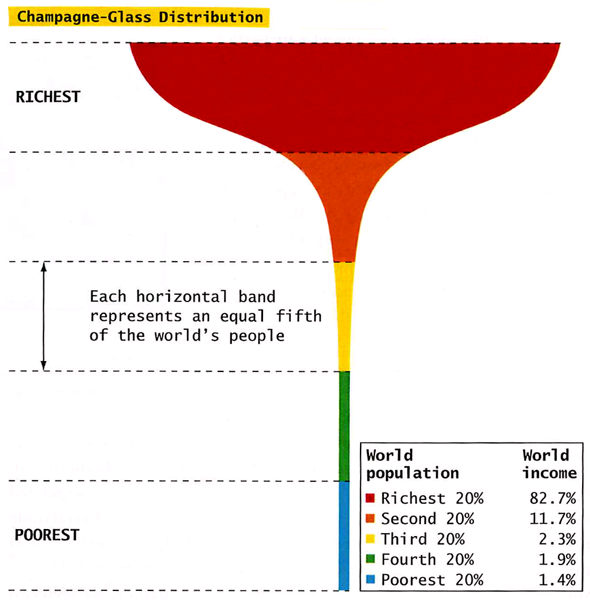
One of the most problematic implications of the premise that God is the sole dispenser of blessings and fortune is that it is hard to reconcile the truth of B with the obvious fact that in the world there are those who are so much more blessed than others. If God is the sole dispenser and cause of blessing and fortune then God is also the cause of misfortune and everything that goes badly, including today's drastic social and economic global disparity.
If God was the cause of the Pilgrims' good fortune, then wasn't God also the cause of their misfortune during winter? If God is responsible for causing fortunes in the world, for good and for bad, then on Monday God may be a benevolent sprirt to be thanked, and on Tuesday a malevolent demon to be cursed.
And on a related note, if God is the cause of such things as the global economic disparity, and there is perhaps some Biblical justification for asserting that God gives wealth to some for the purposes of dispensing justice, then is the proper way of thanking God for our outrageous relative wealth to gorge ourselves on an eight course meal, or would a better practice be prayer, fasting, and stewardship?!
[Aside: Biting the Bullet]
[I'm an Open Theist so I object the premise that God is this interactive with the world, but I must admit that there seems to be a Biblical warrant for simply biting the bullet here and admitting that God is to be both praised for our good blessing and trusted and blamed when things go wrong. God is in control of absolutely everything, we are in the palm of His hand, and we must simply trust Him. Whether God is making the wine flow, or pouring Babylon over us like a pot of boiling water, God is in control and we trust that in the end He will bless us. There is strong Biblical warrant for this, especially in the OT, but I can't get on board with it because I can't see a good God causing pain, even if it's temporary or teleological.]

One strategy of wiggling out of the theodicy issue, which keeps B in tact, is to argue that God's dispensing fortunes and blessings to us is a function of our faithfulness; ie the more faithful one is the more God will bless them. This is what's called "The Gospel of Prosperity," and its about as ugly, and dubious, as it is popular in our Country.
While this does indeed wiggle out of the theodicy issue, and preserve B, it runs into four troubling issues immediately. The first is that it's doubly cruel to the poor. The poor are not just pitiful, but they are poor because God has caused them to be that way, and God has caused them to be poor because of their own doing. Charity then would be resisting the due punishment of God. Talk about insult to injury!
The second devastating problem for the Gospel of Prosperity is that it's simply easily debunked by even a cursory examination of the world. If God's blessings were a function of our faithfulness, then why do jerks seem to have it so good and saints get nailed to trees? Why do Wall Street Bankers make tens of millions of dollars and earnest school teachers make less than minimum wage?
A third with the Gospel of Prosperity strategy is that its explicitly countered in the Bible time and time again. The entire purpose of the story of Job is to show that faithfulness and fortune are not correlated in any way, and Jesus asserts several times that the poor are not poor because of anything they have done (cf John 9:1-2).
In fact Jesus goes so far at points to completely undermine the Gospel of Prosperity by asserting the exact opposite correlation between faithfulness and fortune: "If anyone desires to come after Me, let him deny himself, and take up his cross, and follow me" (Matt 16:24). Faithfulness and fortune may in fact have a causal relationship, but it's an inverted one!
"The LORD Be With You"
What would a better theology and practice of thanks look like? I don't know the answer to that, as I'm more of a smasher of other people's ideas than I am of a builder of theories, but here is one attempt at a promising start.
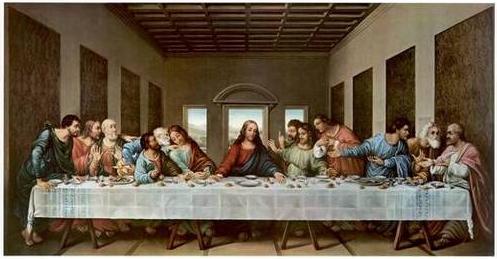
A theology of thanksgiving that may be superior would be to simply give thanks to God in the way we have been doing for thousands of years every Sunday in the Eucharist: gathering the family together for prayer and food in the Great Thanksgiving of Eucharist to give thanks to God for what God has done, what God is doing, and what God will do.
Surely we are on safer ground when instead of thanking God for supposedly blessing us with health, wealth, and happiness, we give thanks to God for sending God's son Jesus, the Jewish Christ/Messiah, the one LORD incarnate, and savior of all to take on our nature, teach us, and assume our sinful form in order to put it to death. Or said in a much better way:
"Holy and gracious Father: In your infinite love you made us for yourself; and, when we had fallen into sin and become subject to evil and death, you, in your mercy, sent Jesus Christ, your only and eternal Son, to share our human nature, to live and die as one of us, to reconcile us to you, the God and Father of all. He stretched out his arms upon the cross, and offered himself, in obedience to your will, a perfect sacrifice for the wold world....Therefore we proclaim the mystery of faith...[and] We celebrate the memorial of our redemption, O Father, in this sacrifice of praise and thanksgiving" (BCP 362-3).
Surely this is something that everyone can give thanks for and "it is a right, and good, and joyful thing, always and everywhere to give thanks" to God.
Monday, November 25, 2013
A Critique of Pure Spirit
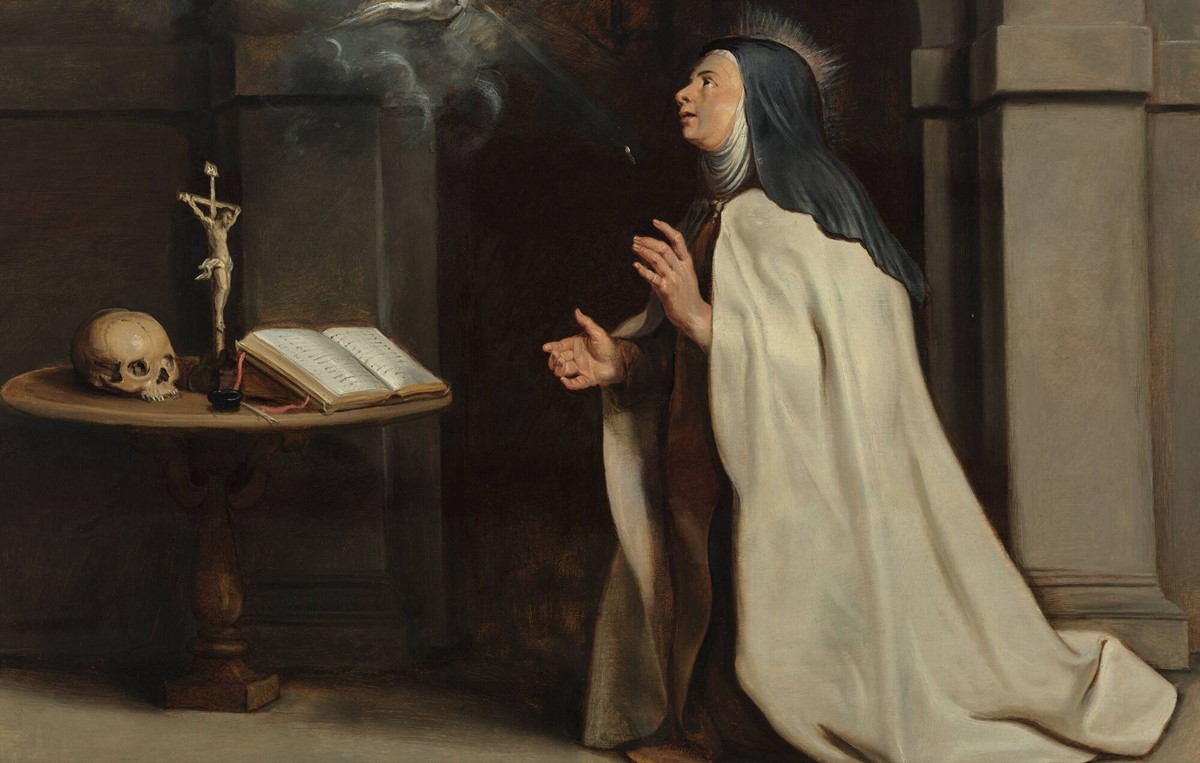 From St. Polycarp in the first century who said he had a mystical vision foretelling his death by fire, to St. Francis who said he experienced the divine in all living things, to Jullian Norwich who claimed to have sixteen revelatory visions of heretical content, to St. Teresa of Avila who had visions of her soul being lifted out of her paralyzed body to unite with God, to the current wildfire that is Pentecostalism in the global south, to everyone today who proudly claims that they are “spiritual and not religious,” to the current evangelical emphasis on a “personal relationship with Jesus Christ” (despite the fact that they’ve never actually met him in person), to “contemporary” worship services that aim to get people to “experience God,” there is river of mysticism that runs the entire length of Christian history.
These mystics, in their own way, all claim to somehow have access to some sort of spiritual knowledge/experience which informs the way they live and gives ultimate meaning to their lives. Such information would indeed seem to be very important(!), but are these mystical claims not epistemologically problematic? How do these Christian mystics know about this spiritual realm of information at all? How do they gain access to it, and by what mechanism do they appropriate its data? Despite the great number of these averring mystics, the claim of having access to secret mystical/spiritual data simply breaches the boundary of the normal epistemological limitations of human beings.
What exactly is “mysticism,” and what do we here mean by “Christian mysticism.” Ayn Rand's definition is both clear and helpful:
Mysticism is the acceptance of allegations without evidence or proof, either apart from or against the evidence of one’s senses and one’s reason. Mysticism is the claim to some non-sensory, non-rational, non-definable, non-identifiable means of knowledge, such as ‘instinct,‘ ‘intuition,‘ ‘revelation,‘ or any form of ‘just knowing.‘[…] Mysticism is the claim to the perception of some other reality — other than the one in which we live — whose definition is only that it is not natural, it is supernatural, and is to be perceived by some form of unnatural or supernatural means.
(Ayn Rand, “Faith and Force: The Destroyers of the Modern World,” qtd in The Ayn Rand Lexicon: Objectivism from A to Z, ed. Harry Binswanger (New York: Meridian, 1986), 322. )
Mysticism is then, by definition, the epistemological claim to know information which is not gained through the senses or deduced by logical analysis. “Christian mysticism” is closely related and simply denotes mysticism whose content is Christian in nature.
With this firm and clear definition in place, the decisive blow has been already struck. All we have to do is unpack the logical implications, to wit mystical claims are by definition epistemologically impossible because they violate what it means to “know” something.
Simply by analyzing our concept of knowledge and observing how the word “know” functions for us in our particular language game we can deduce and assert that there are three necessary criteria that all things that are said to be “known” must share: the claim must be 1) true, 2) justified, and 3) believed.
Regardless whether a mystical reality 1) truly exists ontologically (which seems impossible to confirm or deny entirely), or 3) if mystics do truly believe their own claims (which they seem to), such claims are 2) epistemologically unwarranted because the lack adequate justification.
What does it mean to have adequate “justification” for a claim? In the same way that we broke “knowledge” down into three necessary constituent conditions, we can use the same process to break down our concept and use of the word “justification.”
Simply by analyzing our concept of what it means for something to be “justified,” and by observing the way we use the word in our particular language game, we can deduce and assert that for a claim to be “justified” it must be have at least these two necessary conditions: empirical verifiability (ie it must be sensible), or logical deducibility.
Simply by analyzing our concept of what it means for something to be “justified,” and by observing the way we use the word in our particular language game, we can deduce and assert that for a claim to be “justified” it must be have at least these two necessary conditions: empirical verifiability (ie it must be sensible), or logical deducibility.
Now that we have definitions of our key terms and concepts (“mysticism,” “knowledge,” and “justification”) we can state the argument, why mystic claims breach the normal human epistemological barrier, quiet succinctly using overlapping modus tollens and modus ponens argument forms.
P1: If a claim is justified, then it is either empirically verifiable or logically deducible.
P2: Mystic claims, by definition, are neither empirically verifiable nor logically deducible.
C1/P3: Mystic claims are not justified.
P4: If a claim is not justified then it is not knowable.
C2: Mystic claims are not knowable.
To state it even clearer we can translate the argument into sentential symbolic logic in the following way:
J -> (E v L)
Mystic claims are ~ E & ~ L
∴ Mystic claims are ~J
Mystic claims are ~ J
~J -> ~ K
∴ Mystic claims are ~ K
One of the strengths of this argument is that it seems to avoid a well-known objection to Logical Positivism. Said objection states that the proposition “only those claims which are either empirically verifiable or logically deducible are justified” is itself not empirically verifiable nor logically deducible, and therefore by its own standards is an unjustified claim.
However, the present argument seems to avoid that objection because the claim that “only those claims which are either empirically verifiable or logically deducible” is shown to be not self-contradictory, but instead, is itself, both empirically verifiable and logically deducible.
As stated above, when we empirically observe the use of the word “justify” and its function in our language game we come to the conclusion that what we mean when we say “justify” is that a claim is either empirically verifiable or logically deducible.
As stated above, when we empirically observe the use of the word “justify” and its function in our language game we come to the conclusion that what we mean when we say “justify” is that a claim is either empirically verifiable or logically deducible.
Likewise, as stated above, when we logically analyze the concept of “justification” we simply conclude that its necessary constituent parts are empirical verifiability and logical deduction. What else could “justification” mean? When a claim is either empirically verifiable or logically deducible then it seems right to conclude that the claim is justified.
This move may seem like a dubious begging of the question, but is it not the same process that we use to deduce the answer to the question “1 + 1 = ?” Simply by analyzing the definition of “1” and the function of “+” we can deduce the answer. Simply by analyzing our concepts of math functions we are able to deduce certain conclusions. In the same way, when we simply analyze our concept of “justification” we can deduce what its necessary constituent parts are.
By way of concluding this knotty investigation, let us consider the shark. Unlike humans, sharks can sense the electromagnetic fields of other living organisms. Humans do not have the necessary biology to sense electromagnetic fields, and so if a human were to claim that she could also do this then her claim would be dismissed out of hand because it is impossible for her to have that sort of knowledge. Just as it would be impossible for a human to claim to know what the electromagnetic field is of another living organism, mystics cannot know what is by definition unknowable.
Wednesday, September 11, 2013
Bored with Borg's Book
Borg’s Boring Project
It doesn’t take a Ph.D. in church history to sense that what used to be Jesus’ simple teachings about

Sacking Salvation
One of Borg’s most important, and problematic, theological moves is to bifurcate what he calls the “pre-Easter” Jesus with the “post-Easter” Jesus. The former is the “historical” Jesus, and the later is the Jesus the Church created and adorned with theological embellishments decades after the fact. This distinction may seem at first to be a useful and benign philosophical construct, however if the historical Jesus is significantly different than the church’s christological doctrines then the fault is set for major theological earthquakes and the whole house of cards will soon collapse.
For example when Borg writes, “The image of Jesus sketched in this chapter suggests that the answer is ‘No, the pre-Easter Jesus was not God,’” the hook is set to undercut ancient and authoritative teachings about the way we are saved which rely heavily on Christ doing and being exactly what the Church has said that he did and is (Marcus Borg, Meeting Jesus Again for the First Time: The Historical Jesus & the Heart of Contemporary Faith (San Francisco: Harper Collins, 1994), 37). For example, Gregory of Nazianzus once famously said, “that which [Christ] has not assumed He has not healed” (Gregory of Nazianzus, qtd in William C. Placher, A History of Christian Theology: an Introduction (Louisville: Westminster John Knox Press, 1983), 81). If Borg is right and the real historical Jesus was not also God incarnate then our very salvation is at stake!
The Historian’s Magic Trick
Nonetheless, if Borg’s theory is correct, then even if it brings down the whole house of Christian theology it should be embraced, and therefore we should now carefully consider the validity his historical analysis itself. Borg is a modern exponent of a much larger academic project called “The Quest for Historical Jesus” which has dominated New Testament studies for the past two hundred years. The Quest argues that a well equipped historian can construct a full and accurate portrait of Jesus distinct from the theologically ladened witnesses we have in the Gospels.
For example, one of the tools that the historian is supposed to be able to use to make such determinations is the criteria of “dissimilarity.” This method aims to find authentic original aphorisms of Jesus by examining a saying to see if it is just part of the Jewish cultural milieu of Jesus’ time (and therefore not original material) or if it seems to be too similar to later theological formula of the church (and therefore not authentic).
This seems at first to be a promising criteria for determining original and authentic sayings of Jesus, but the problem quickly becomes apparent when one asks what the results might be if this same criteria was placed on a modern figure such as Martin Luther King Jr. Would it be a fruitful project to conclude that only those sayings of MLK that were dissimilar from both the Black Church tradition and the Civil Right movement were authentic and original? Of course not! The historical Jesus is lost to us, and all we have presented to us now are the faithful witnesses of the Gospels. As Rudolph Bultmann once said, “I do indeed think that we can now know almost nothing concerning the life and personality of Jesus.” (Rudolph Bultmann, qtd in Powell, 11). There is no getting “behind” the received texts to the historical truth; the method of transmission and the message are inseparable.
Reconstructing the Historical Jesus Borg
While Borg’s project may be theologically and historically problematic, the portrait that he draws of his “historical” Jesus is “a vivid and persuasive description,” yet perhaps problematic in itself as well (Powell, 103). Borg envisions Jesus as a deeply spiritual person who connected to God in a tangible yet mystical way, a healer with powers over demons, a charismatic teacher of wisdom who claimed to have intimate knowledge of God, and a social prophet who offered an alternative vision for society as a whole. This is a compelling vision of Jesus, and one that takes seriously the political and social implications of Jesus’ teachings.
However, it does seem rather suspicious that Borg’s Jesus seems to affirm exactly the same sorts of things that Borg himself is invested in. For example, Borg is the professor of “religion and culture” at Oregon State University, and as his position’s designation implies he is heavily invested in the relationship between matters of faith and sociopolitical realities. Borg is also particularly interested in a wide variety of spirituality and mysticism as a student of world religions. In short, Borg seems to have “objectively historically reconstructed” Jesus into his own image: a liberal, idealist, mystical, activist.
Hays writes, “...despite the apparent objectivity of beginning with an appeal to the ‘historical,’ the history of New Testament research demonstrates that efforts to reconstruct the historical Jesus have been beset by subjectivity and cultural bias...and the problem continues unabated in the present renewed outpouring of studies of the historical Jesus” (Richard B. Hays, Moral Vision of the New Testament). Borg seems to fall right into the common trap of the historical reconstruction of Jesus — creating God in his own image.
Re-Introducing Jesus
Having now briefly surveyed Borg’s work in terms of it’s theological, historical, and methodological substance, we are in a good place to say something about his implications for and use in ministry, specifically in the Episcopal Church. It has been my experience that the Episcopal Church is often the site of recovery for people who have been battered and bruised by the brutal forms of Christianity out there today, and for those people I think Borg may indeed be helpful and edifying, but perhaps only spuriously so.
The work of Borg and the Jesus Seminar could “open a window of opportunity for significant consciousness raising and education within the church...it could provide a way for people to be both thoughtful an Christian, rather than having to choose between the two” (Marcus Borg, qtd in Powell, 65). Even so, Borg is not where I would start the process of healing a post-Christian person nor introducing a neophyte to Christ because in the long run the “Quest’s” project may do more harm than good. Instead, I’d re-introduce them to the incarnate man from Galilee in the exact way that the church has been doing so for centuries — through the narrative passed down to us in the canonized Gospels.
Sunday, July 14, 2013
Saturday, May 11, 2013
A Voice in the Wilderness: Reflections on Phyllis Tickle’s The Great Emergence and Its Implications for the Episcopal Church of Tomorrow
“No one sews a piece of unshrunk cloth on an old cloak, for the patch pulls away from the cloak, and a worse tear is made. Neither is new wine put into old wineskins; otherwise, the skins burst, and the wine is spilled, and the skins are destroyed; but new wine is put into fresh wineskins, and so both are preserved.”
Matthew 9:16-17

On the cover of Phyllis Tickle’s The Great Emergence is a single portrait composed from four artistically distinct representations of Christ. By stitching together several different images, a new eclectic picture emerges, and in essence, the cover of Tickle’s work closely mirrors the book’s central argument of how the face of modern day Christianity is once again undergoing a semi-millennial upheaval as it morphs into a poly-blend of four main strands of "traditional American Christianity" (p. 133).
Tickle’s thesis has a few problems however, but nonetheless leaves church leaders of tomorrow with a handful of important and challenging questions about what effective ministry in the future will look like.
Argumentative Problems: Oversimplification, Logic, Inaccuracies
Tickle spends a majority of her book looking back at several of the sea changes Christianity has gone through over the last 2,000 years, and drawing parallels between them in order to argue that the modern day church is also in the midst of a similar dramatic change and may have some of the same outcomes including liturgical reform, doctrinal realignment, a new fresh spirit in both the new and old tradition, as well as wars and pandemics.
Tickle writes, “...the only way to understand what is currently happening to us as twenty-first-century Christians in North America is first to understand that about every five hundred years the Church feels compelled to hold a giant rummage sale...about every five hundred years the empowered structures of institutionalized Christianity, whatever they may be at the time, become an intolerable carapace that must be shattered in order that renewal and new growth may occur” (16).
Such a grand sweeping historical thesis would be truly important and illuminating for the church’s self-reflection, but unfortunately, at the end of the day, her historical analysis is simply too superficial to lift her ambitious thesis and her cursory treatment of historical facts leads almost inevitably to oversights, logical fallacies, inaccuracies, and unlikely conjecture.
At the heart of Tickle’s historical analysis is the assertion that about every five hundred years the church goes through a major change: the time around Gregory the Great, the Great Schism, and the "Great" Reformation. The church has of course gone through great reform at these times, but the church has undergone many more dramatic events and changes than just those few. What about the dramatic socio-political shift in the fourth century under Emperor Constantine the Great? Or the ocean of theology poured out on the church by the great “Doctor of the Church” Thomas Aquinas in the thirteenth century. Or the bi-continental revivals during “The Great Awakenings” whose theological narrative is still dominant today among a grand majority of evangelical Protestants in America?
For its entire life Christianity has been undergoing change and challenge; focusing on only the ones that happen every five hundred years is like drawing a constellation using only a few select stars in the sky: yes a picture can be created, but there are many more stars in the sky and more than just one picture that can be created with them.
A second problem is logic. Citing a skeptic is normally a ten yard penalty in productive discussions, but Hume's emphasis on the fallacy of inductive prediction is helpful in debunking Tickle's repeated claim that previous Christian periods of reform can help us understand and predict what will happen in the alleged current one. For example, if someone had a bag of apples and pulled them out one at time and they all happened to be green does mean that one can logical conclude that the very next apple taken out of the bag won't be red. Put more specifically, even if there was a current reformer named Luther nailing 95 Theses to church doors, that still wouldn't mean that we could assume to understand anything about this new reformation or predict how it will unravel. The past simply cannot predict the future logically.
There are also several places where Tickle simply gets her history wrong. For example one of the most brazen errors occurs in her discussion over how Greek philosophy mutated Christian theology into a dualistic religion that then despised the physical temporal world (p. 161). Christianity undoubtably used and learned from Greek philosophy (specifically neo-Platonism and Stoicism), but it is completely untrue that Christianity therefore despised the physical world. The endless Arian controversies of the fourth century leave no room for doubt on that topic.

In addition to her troubles regarding previous times of great change in the Church, Tickle's prediction of the “Great Emergence” itself may also have some difficulties. The central tenant of her description of the Emergence is a Christianity that is blend of four currently distinct traditions. This sort of melting-pot theory was also the predicted result of the “Americanization” of many culturally distinct immigrants in the 18th century. However, it simply did not come to pass, and instead what emerged was a “salad bowl” of culture rather than a homogeneous blending of cultures. Perhaps then Tickle is incorrect in her prediction of such an ecclesiastical blending. Only time will tell.
Important Challenging Questions
Tickle’s historical thesis may need further development, but despite its deficiencies, her description of the Emergence itself it still raises crucially important questions that the church must face if her characterization of “The Great Emergence” is accurate.
 One of the great unanswered questions that future church leaders are left with vis a vis emerging Christianity is similar to the central dramatic question raised in the critically acclaimed period drama “Downton Abbey:" how will Downton weather the financially trying and culturally changing times of the post War world? Up until the War, the Abbey's residents had blissfully and naively existed in their insular routines and had been coasting on timely infusions of capital despite being overstretched and financially mismanaged for years.
Similarly, in the midst of such a metamorphosis of ecclesial culture how can the modern day church merge arcane ritual practices with modern sensibilities, continue to maintain huge aging physical edifices, train and employ expensive highly specialized staff, and still continue to benefit its local community in a meaningful way?
Will this new emergent melting-pot church turn out to be “The Great Abandonment” of the polity, principles, and property of the preceding parish? Will this new emergent spiritual revival spell financial ruin and the de-professionalization of ministry? Would that be entirely negative for the authenticity of the Church and God’s work in the world? Jesus once said that “you can’t put new wine in old wineskins,” does that mean that this new emerging spirit can’t be housed within the current structures of the Church without irreparably damaging each?
Will this new emergent melting-pot church turn out to be “The Great Abandonment” of the polity, principles, and property of the preceding parish? Will this new emergent spiritual revival spell financial ruin and the de-professionalization of ministry? Would that be entirely negative for the authenticity of the Church and God’s work in the world? Jesus once said that “you can’t put new wine in old wineskins,” does that mean that this new emerging spirit can’t be housed within the current structures of the Church without irreparably damaging each?

Phyllis Tickle’s The Great Emergence is a voice crying in the wilderness proclaiming the changing of a season, and can be a wake-up call to entrenched churches to repent and change their ways to receive new life in this next outpouring of the Spirit. It is the opinion of this author that the Episcopal Church is in a theologically advantageous position for this Emergence because within its very DNA exists a deep tolerance for a variety of voices and a rich tradition that balances “holding fast to that which is good” and “singing to the Lord a new song.”
Sources:
Phyllis Tickle, The Great Emergence: How Christianity is Changing and Why (Grand Rapids: Baker Books, 2008).
Monday, May 6, 2013
Top Three Theological Topics for Teens: Forgiveness
St. Thomas Youth Group
5/5/2013
“The Top Three Theological Topics for Teens: Forgiveness”
Intro:
Hey everybody, it’s really good to see all of you here tonight. It’s a busy time of year with end of school projects, state wide standardized testing, proms, and end of season sports tournaments. With all that going on I’m proud of you for making your community of faith a priority.
Prayer:
Tonight we’re going to continue our series on “The Top Three Theological Topics for Teens”, but before we dive right in let’s start with a prayer:
“Father God, you see your children growing up in an unsteady and confusing world. Show us that your ways give more life than the ways of the world, and that following your son is better than chasing after selfish goals. Help us to take our failures, not as a measure of our worth, but as a chance for a new start. Give us strength to hold our faith in you and to keep alive our joy as your creations. Through Jesus Christ our Lord. Amen.”
Review:
As I said, tonight we’re going to continue our series of looking at some of the top theological topics and scripture passages that are relevant for teenagers in today’s world. Last week we looked at the verse “the spirit is willing but the flesh is weak," and explored the theme of temptation. We saw that teens today are in a really tough spot and are uniquely vulnerable to temptation because of powerful sociological and biological reasons.
Tonight’s Topic: Forgiveness
Tonight we’re going to build off of what we talked about last week and talk about failure. With so many pressures and forces against you, you’re going to fail, just like everyone does. Romans 3:23 says “all have sinned and fallen short of the glory of God.” That means that sometime in life, we’ve all screwed up royally, and that we’re in the same sinking ship. So tonight we’re going to talk about what happens when we fail.
Video:
To kick us off in that direction I want to show you a short video created by a very creative and famous pastor named Rob Bell.
Forgiveness Roadblocks:
“Nothing you can do can make God love you any less.”… I think that’s kinda hard to really understand, at least it is for me. I think that’s partly due to the fact that if you grow up in the church you’re told constantly “God loves you” so much that eventually it has no real meaning anymore.
I also think it’s hard for young people to grasp the power of God’s undeserved love for them because in this culture young people are constantly told that they are super special, that they are the key to the future, that they are the children of promise and full of world changing potential, that young people are the most precious things in the world, etc. If young people really are that important, then of course God loves you, and saying it is about as special as pointing out that the sky is blue or grass is green. It’s just not that interesting.
The church and it’s weak versions of the gospel, and the sentimental culture have inoculated young people from the real meaning and power of the gospel’s message.
"Those who are forgiven much, love much"
But if you’ve ever screwed up, I mean royally screwed up, then you know what God’s love really means deep down. So let me just talk for second here to those of you who aren’t perfect, you know who you are. Those of you who are perfect can just zone out for a while.
You may feel that you’re the worst person in the world, or that you’ve committed the worst possible sin, you may feel ashamed, or disappointed in yourself, or you may have sudden attacks of anxiety and fear that someone may find out, you may feel isolated and that there’s no one you can talk to about the way you feel because you don’t want to reveal specifically what you’ve done, you may be overly defensive for no reason, or try to mentally justify your actions, you may be depressed and thinking about suicide, you may have an overwhelming sense of guilt like a dark cloud that fills the entire sky.
The Good News:
If that describes you then let me lay some good news on you. In Romans 5:8 it says “In this God proves his love for us, that while we were still sinners, Christ died for us.”
And later Paul writes, “Who will separate us from the love of Christ? Will hardship, or distress, or persecution, or famine, or nakedness, or peril, or sword?...No in all these things we are more than conquerors through him who loved us. For I am convinced that neither death, nor life, nor angles, nor rulers, nor things present, nor things to come, nor powers, nor height, nor depth, nor anything else in all creation will be able to separate us from the love of God in Christ Jesus our Lord.”
In 1st John 1:9 it says “If we confess our sins, he who is faithful and just will forgive us our sins and cleanse us from all unrighteousness.” And in Proverbs 28:13 it says “No one who conceals transgressions will prosper, but one who confesses and forsakes them will obtain mercy.”
Listen everybody, “Nothing you can do will make God love you less.”
Conclusion:
As a way of closing I’d like to share with you a song written by the christian band “Third Day.” This song literally changed my life one day when I was your age. The song is written from the view point of God the Father writing a letter to us his children.
In the name of Jesus Christ, you are forgiven! Amen.
Subscribe to:
Comments (Atom)